Posts

What Did I Come In Here For? The Brain Fog Of Lockdown
Image
  Did you find it hard to concentrate on anything during the lockdown? Perhaps you found your memory was worse, what has commonly been called brain fog? How many times have you felt exhausted after a day of online meetings? You were not alone. The good news is that as we come out of the restrictions we are likely to find the fog will clear, but researchers are interested in why this happened. I read an interesting article in the Guardian today, that explored some of the work that has been going on studying the behavioural and cognitive effects of a restricted lifestyle during the lockdown, and I wanted to share some of the points as a way of reassuring ourselves that it appears to be a normal psychological response. A Normal Response to Abnormal Circumstances Psychologists agree that cognitive impairment is an expected response to trauma. We remind ourselves that trauma is as much the change to our everyday routine as being directly affected by the pandemic itself. We remember th...
Challenge Self-Doubt: Coaching and Hypnotherapy

Image
  “I know what I should do, but I’m not sure that I could do it.”  This is a ‘what if?’ comment. When we think about making changes in our lives we can sometimes put blocks in our way with ‘what if’s”. What if I fail? What if it is a mistake? What if I regret it?  More often than not we spend time thinking about the downsides of the change rather than the benefits, even though the positives were exactly what created the desire to change in the first place.  Negative focusing is a powerful force in stopping us from progressing in the way we should. The key is to get into the habit of reframing the negative ‘what if?’ into a positive statement of what is going to happen. I am all in favour of positive imagination and dwelling on what our life will be like when the goal is achieved, but it is important that it is always framed in a positive way.  The most important thing to understand is how to reframe or rather change that negative view into dwelling on what if y...

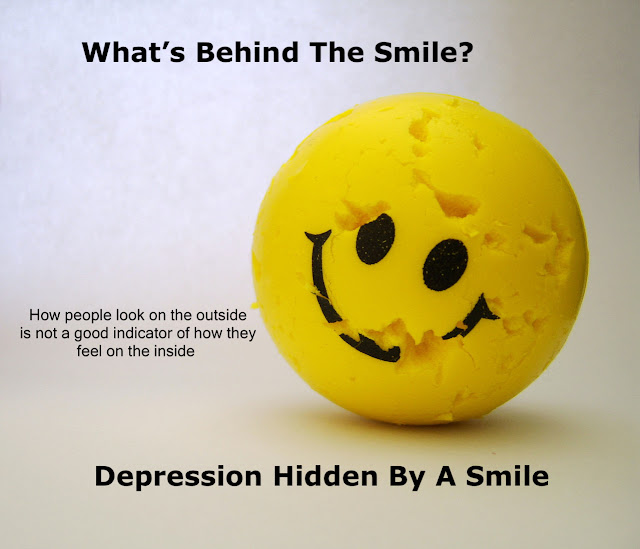
Depression Hidden By A Smile

Image
  The term Smiling Depression has become more common over the last few years and refers to the way many people can have low mood while still functioning day-to-day.  Often they are so successful that friends, family and work colleagues would be surprised to know how they were feeling behind the smile. Typically a client will explain how they have learned to put up a front of being okay because that’s what everyone expects from them. They go through the motions of playing along with the ‘role’ they have learned to play which hides the truth that their low mood is more persistent than many would believe. When we think of famous people like Robin Williams it is clear that he was smiling through his depression, playing the comedy role the world loved him for. What does this tell us? How people look on the outside is not a good indicator of how they feel on the inside. Low mood and mild depression are not just feeling sad, it can be an absence of emotion. Often we refer to a flatt...

What's Your Talent? And Why it's Important to Know

Image
  What’s your Talent? Have a think about it… because you do have one, I promise. You might not know that you do, but we all have a talent for something. If you haven’t recognised what it is yet, think of what a benefit it would be to you and other’s once you understand your talents and exploit those in your day-to-day life. The experiences we have (including our interactions with others) shape our expectations about future outcomes. As a way of dealing with potential ‘threats’ in our lives, we use models of past experience to inform us about what we should do. Of course, we haven’t experienced everything, so we used the best fit option. We match similar experiences with future ones and develop an expectation based on those. It stands to reason that a person who has had experiences and interactions that were interpreted as evidence that they are not as good as others, will be less successful and just have to make do with what they have. They are more likely going to find it difficul...

Negative Thinking? Question the Evidence

Image
  In my blogpost Anxiety: The Mind’s Fake News , I explained how anxious and negative thoughts are largely based on false information. The fake mind news is the product of an overestimation of potential threat. We worry and feel stressed as a precaution to the perceived threat in our environment. Our mind tells us one thing and the reality is something different, but we better be on our guard because what if something bad were to happen. It is difficult to grasp sometimes that this thought process is not always at a conscious level. Negative thinking creeps in and we were unaware of why we should feel that way. The fake negative warning signal comes from within our mind with the result being a conscious battle with the reality of the situation. The Burglar Alarm In Our Mind A teenage client of mine once described it as a burglar alarm going off but there was no burglar in the building. You look for evidence of an intruder but there is no-one. You take a moment to reset only for the...

Practical Ways to Help Teenagers with Stress and Anxiety

Image
  More and more I am being contacted by worried parents whose teenage son/daughter is struggling with stress and anxiety. Some have become overwhelmed with the school changes due to the pandemic, and other’s have found that their anxiety symptoms have flared up and both parent and teenager don’t know how to cope.  Anxiety is our mind telling us lies. In my blogpost: Anxiety: The Mind’s Fake News , I explain that it is an early warning signal that our mind has used since we were primitive nomads. We are programmed to overestimate the potential threat in a situation because then we are protected from danger even when our estimation was incorrect. One of my teenage clients described it as a faulty alarm ringing in a building but there wasn’t a burglar. Even though everything was safe and calm in the building, the alarm kept sounding. It is very stressful for the building owner to have to manage the faulty alert, particularly when they had no idea why the alarm kept sounding. In o...

Five Ways to Boost and Maintain Your Resilience During Lockdown

Image
  It’s another lockdown and psychological resilience is going to be particularly important. At times like these, we can feel overwhelmed, largely because things feel out of our control, but there are a few things you can do to take control of how you respond to the changing circumstances. Make a plan - Take charge with Problem Focused Coping Having a plan is something that psychologically puts our feet on the ground and gives us a sense of control. Plan small things as well as big things. Ask yourself what you need to right now, what is the most important thing you need to focus on right now? It may be something big like sorting out your finances, organising work, or how you are going to juggle online schooling as well as that zoom meeting. These are important… but remember they cannot be perfect! This is not a perfect situation, so the way you respond to it is unlikely to be perfect too. Like everyone else you make the best of the situation and do what you can. Plan some smaller t...